
The selection of an undergraduate degree is one of the widest choices that a student can make.
It determines your future career, determines how much you will earn, and allows you to develop the skills required in the contemporary job market.
Associate degree, bachelor's, major, minor, honors, and foundation year are some of the terms that many students are confused with when they are first introduced to them.
The positive aspect is that with the knowledge of the basics, it becomes very easy to understand the undergraduate degrees.
This guide will tell you everything about undergraduate education, the types of degrees available, the duration of the degree, the advantages of the degree, and how to select the most suitable one for your future.
What Is an Undergraduate Degree?
The first level of higher education is an undergraduate degree, which students pursue when they are done with school or college. It is the initial qualification that is often taken in a university or college before proceeding to postgraduate studies.
Undergraduates are students who are pursuing their first university degree. Associate degrees and bachelor's degrees are the most popular forms of undergraduate degrees.
Undergraduate degrees are structured in such a manner that they provide students with a general knowledge of a topic as well as equip them with skills in practical, research, communication, and problem-solving.
To a large number of individuals, an undergraduate degree is the beginning of a professional career. It is also a stepping stone to the postgraduate qualifications, such as a master's degree or a PhD.
Why Undergraduate Degrees Matter
An undergraduate degree is more than just a certificate. It can open access to better employment, increased wages, and increased career opportunities.
The U.S. Bureau of Labor Statistics research indicates that the wages of employees with a bachelor's degree are much higher in comparison to those of employees who have only a high school diploma.
The graduates are also less likely to lose their jobs, and they have higher prospects of developing their careers. Degree qualification has remained a shortlisting technique used by many employers, particularly in professional jobs in business, healthcare, engineering, education, and law.
Meanwhile, the worth of a degree, in most cases, can be determined by the major, the school, and the useful skills acquired in the course of education.
Main Types of Undergraduate Degrees
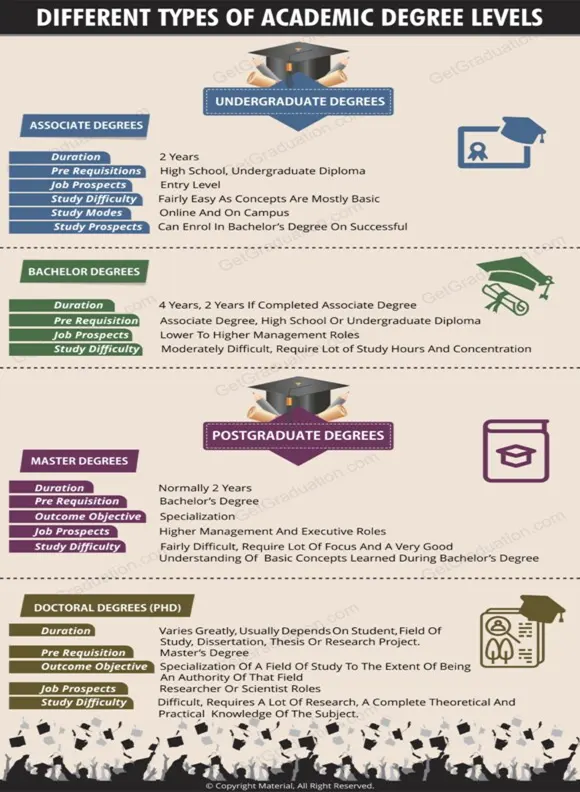
Undergraduate degrees are of two major types:
Associate Degree
In most cases, an associate's degree is obtained in two years. Community colleges, technical colleges, or vocational institutions usually offer it.
This kind of degree is suitable for students who desire:
- A shorter time of study
- Lower tuition costs
- Rapid access to the labor market.
- A pathway leading to a Bachelor's degree
Technical, healthcare, information technology, and business support are some of the common associate degrees that are in high demand.
Some common types of associate degrees are as follows:
- AA - Associate of Arts (AA)
- AS - Associate of Science (AS)
- AAS - Associate of Applied Science (AAS)
AAS tends to be more career-oriented, whereas AA and AS degrees are generally aimed at students who might proceed to take a bachelor’s degree.
Bachelor’s Degree
The most prevalent form of undergraduate qualification is a bachelor's degree. The standard duration is three to four years of full-time study based on the course structure in the country of study.
Bachelor's degrees offer more subject-specific content as compared to associate degrees, and in most cases, they are essential in professional careers.
The most frequent forms of bachelor's degrees are:
- Bachelor of Arts (BA)
- Bachelor of Science (BSc or BS)
- Bachelor of Engineering (BEng)
- Bachelor of Laws (LLB)
- Bachelor of Fine Arts (BFA)
- Bachelor of Business Administration (BBA)
A BA degree tends to emphasize the humanities, arts, social sciences, and communication. BSc is more science, mathematics, technology and analytical oriented.
Difference Between BA and BSc Degrees
A good number of students are not able to choose between a BSc degree and a BA.
The BA degree is more liberal and can incorporate such subjects as literature, history, media, politics, psychology, or sociology. It tends to promote creative thinking, writing and communication abilities.
The BSc is typically more specialized and aims at science-oriented courses like biology, engineering, computing, data science, nursing or chemistry. It tends to have more laboratory work, mathematics and technical training.
Both degrees are not superior to the other. The correct decision will be based on what you like, are good at, and what your career objectives are.
The Duration of an Undergraduate Degree
Undergraduate degree duration varies depending on the nature of the qualification and mode of study.
Here is the general idea about its duration:
- Associate degree: It takes around 2 years to complete
- Bachelor’s degree: Requires 3 to 4 years
- The Sandwich degree with work placement: Approximately 4 years
- Part-time degree: May be protracted according to the schedule.
- Double degree: May take 4 to 5 years
Other universities have integrated foundation years in order to accommodate students who do not have the immediate entry requirements. These are programs that are included in addition to the main degree and are one year prior to the start of the degree.
What Subjects Can You Study?
The most remarkable part of undergraduate education is the enormous number of subjects that can be studied.
The areas available to students include:
- Business and Management
- Law
- Engineering
- Nursing
- Psychology
- Computer Science
- Education
- Media and Communication
- Accounting and Finance
- Architecture
- Art and Design
- Sociology
- Marketing
- Environmental Science
Some students choose a subject because they are passionate about it. Some of them concentrate on those topics that would provide good career prospects or better pay.
Business, technology, healthcare, and engineering are also among the most popular degrees due to the fact that these are directly related to other industries that are growing and in high demand in the job market.
These degrees are not easy. But there are specialized writers like MBA Assignment Helpers for business students to help them complete their degrees.
What Is a Major and Minor?
In most universities, particularly in the United States, students select a major and even a minor.
A major is the primary course that you pursue in your degree. For instance, when you take a business major, your options could be marketing, finance or management.
A minor is a secondary course that complements your major. A student who is doing a major in business can minor in psychology or communication.
This system provides students with greater flexibility and enables them to develop a greater skill base.
What Is an Honors Degree?
An honors degree is a more advanced bachelor's degree qualification that generally entails more advanced study in the final year or research project.
In other nations, such as the UK, the honors degrees are mostly categorized as:
- First Class Honors
- Upper Second Class Honors (2:1)
- Lower Second Class Honors (2:2)
- Third Class Honors
These categories may be significant in the process of job application or postgraduate education.
Benefits of Studying an Undergraduate Degree
There are many reasons why students choose to study an undergraduate degree:
Better Career Opportunities
A good number of professional jobs demand a minimum of a bachelor's degree. Professions such as nursing, engineering, teaching, and law usually require very strict qualifications.
Higher Earnings
Individuals with undergraduate degrees are usually paid more than those lacking such degrees.
Transferable Skills
The university assists students in acquiring good skills, which include:
- Communication
- Teamwork
- Research
- Critical thinking
- Time management
- Problem-solving
These are skills that can be used in nearly all professions.
Networking Opportunities
Students are able to establish professional networks with peers, instructors, industry gurus, and employers. Such networks help seek an internship or a job.
Personal Growth
Life in the university also makes students more independent, confident, and responsible. Several students learn new interests, talents, and career aspirations at the undergraduate level.
Challenges of Studying an Undergraduate Degree
Even though an undergraduate degree is a great thing to have, there are some challenges associated with it.
Tuition Costs
The cost of university education can be high, particularly in such countries as the United States or the United Kingdom. These may include tuition, lodging, book costs and travelling.
Academic Pressure
Studying at the university may be stressful. Students have to juggle between lectures, coursework, assignments, group projects, exams, and even work part-time.
Time management becomes a big issue for students. That is why they seek help from professional Academic Writers UK to manage their workload.
Uncertainty About Career Choices
There are a lot of students who do not know precisely what they should do after graduating. Changing your mind is a natural thing to do in university.
Some students begin with one major and then switch to another due to new fascinations or due to improved career prospects. One of the advantages of undergraduate education is this flexibility.
How to Choose the Right Undergraduate Degree
It is not always easy to choose the right degree. The number of courses, universities, and career opportunities is so many.
The following are some of the key considerations to make prior to making your decision.
Think About Your Interests
Begin by considering the areas of interest that you like the most. You can like engineering, nursing, or computer science if you love science. A humanities-based degree might be a better option if you like writing, communicating, or studying history.
When you select a subject that you actually like, university will become a lot easier and enjoyable.
Consider Your Career Goals
One should also consider the kind of career they would wish to have in the future.
For example:
- You may require a degree in education if you wish to be a teacher.
- A medical or nursing degree might be required of you if you want to work in healthcare.
- If you are interested in working in business, finance, or marketing, then a degree related to business can come in handy.
- You will require a technical qualification if you want to be an engineer.
Some particular jobs require specialized degrees, like Doctors must have an MBBS.
Research Graduate Employment Rates
The employment rates of graduates in fields such as healthcare, technology, business, and engineering can be higher.
In the meantime, not all subjects in the arts and humanities can provide such immediate career opportunities, but they can nonetheless build such transferable skills.
Look at Course Content
Do not select a degree just because of the title. Two universities can have the same name for the course, but have very different subject matter.
Go through the course modules and look to see whether they contain practical training, placements, internships, or study abroad.
Think About University Reputation
University reputation may be an issue at times, particularly in a very competitive industry.
But it is not the only thing that employers are concerned about. Equally important are work experience, skills, internships, and attitude.
The students need to concentrate on the process of locating a university with the right course, support services, and learning environment.
Online Undergraduate Degrees
Online learning has gained popularity over the past few years. There are several universities that currently provide fully online or blended learning undergraduate degrees.
Online degrees are potentially good as they can be chosen by students who:
- Requires a flexible study schedule
- Want to work while studying
- Have to travel miles to study
- Have family responsibilities
- Prefer learning from home
According to research conducted at the National Centre of Education Statistics, millions of students are now enrolling in at least one online course in the course of their degree.
Online degrees are becoming more respected by employers, especially when they come from well-known universities.
Nonetheless, e-learning demands good discipline and time management skills.
Final Thoughts
One of the greatest investments you can make in the future is an undergraduate degree. It can make you more knowledgeable, practical, better in your career choices, and more confident.
Nevertheless, it is necessary to think over the selection of the appropriate degree. The student ought to weigh his or her interests, strengths, career objectives, and financial status before making a choice.
No one undergraduate degree is the best one. But the right choice depends on your personal and professional goals.
The right choice is the one that matches your personal goals and gives you the best chance of success in the future.
So, choose wisely, as an undergraduate degree can be the initial step to a successful and satisfying career with proper planning, encouragement, and dedication.